



Time Well Spent
For decades, building an elementary school schedule was a dreaded administrative task—a puzzle a principal or staff member was tasked with working out in isolation, using whiteboards or spreadsheets. But the landscape of elementary education has dramatically changed—with rising academic expectations, staff shortages, a growing population of multilingual learners and students requiring specialized interventions, and persistent achievement gaps. No longer is it enough just to fit students, teachers, staff, and programs into the day. Today's schedules must strategically align instruction, interventions, and enrichment to meet the complex and diverse needs of all learners. How schools use time is now one of the most important levers for student success.
This article explores how districts that take a strategic, systemwide approach to scheduling—supported by clear priorities and the right tools—can make better use of limited staff, deliver stronger outcomes for students, and even reduce costs. Drawing on insights from districts that have successfully reimagined their schedules, we examine the key elements of this approach and how it can help schools meet the evolving demands of modern education.
Why Scheduling Matters More Than Ever Before
The traditional image of an elementary school—where one homeroom teacher guided students through most of their learning day—is becoming increasingly outdated. Over the past several decades, schools have greatly expanded their programming and staffing to meet broader academic, social, and emotional needs. Alongside classroom teachers, today's elementary schools include reading specialists, multilingual educators, counselors, social workers, behaviorists, instructional coaches, paraprofessionals, and countless other positions. Non-teaching staff in schools has grown by more than 130% since 1970.1
This growth in programming and staffing reflects a deep commitment to meeting student needs, but it has also made scheduling far more complex. Elementary principals now lead multifaceted organizations, tasked with aligning a wide array of staff and programs within the fixed parameters of the school day, limited budgets, and contractual obligations. When scheduling is left solely to individual schools without a cohesive district strategy, it often results in inefficiencies, inequities, and missed opportunities to maximize student support.
Scheduling as a Strategic Lever
A districtwide strategic approach to elementary scheduling reframes the schedule as more than a logistical necessity; scheduling becomes a powerful lever to advance educational priorities. Districtwide strategic scheduling ensures that all students—regardless of their school or grade—have equitable access to core instruction, interventions, enrichment opportunities, and social-emotional learning. It enables schools to maximize the impact of their staff, reduce fragmentation, and better align daily practice with district goals.
The Covid-19 pandemic served as a catalyst for change in scheduling practices. Faced with unprecedented disruption, schools reexamined how they used time and resources. Many implemented staggered arrivals and dismissals, added dedicated social-emotional learning blocks, and experimented with flexible learning models. These innovations, born of necessity, demonstrated how rethinking the schedule can be used to address both student well-being and academic growth.
The lessons learned during the pandemic—about prioritizing what matters most, discontinuing low-impact practices, and creating time for social-emotional needs—should not be forgotten. Instead, they should form the foundation for a more strategic, student-centered approach to scheduling that meets the realities of today's schools.
Foundational Scheduling Best Practices
A robust district strategy for elementary schedules hinges on best practices that dedicate time and staff to the highest-priority areas while ensuring thoughtful and efficient use of resources. The following strategies and best practices are foundational to building schedules that improve outcomes and align with system goals.
1. Clarify Instructional Minute Guidelines and Establish Protected Time
A strong district strategy provides clear instructional priorities, expectations, and guidelines, including specified instructional minutes for each subject. This detail ensures consistency across schools and classrooms, guaranteeing that all students receive similar access and the same number of minutes of instruction. Software tools like DMSchedules can help districts embed required instructional minutes as default settings, making it easier to ensure schedules adhere to districtwide learning goals. District leaders can monitor implementation across the district, ensuring that all schools adhere to expectations, and can see when adjustments need to be made based on enrollment or staffing.
Guidelines should also clearly establish when instructional time should be protected so that students don't experience disrupted instruction in core areas like ELA and math. With software like DMSchedules that provides visibility into homeroom schedules, pull-out services can be scheduled appropriately to adhere to these guidelines.
2. Institute Dedicated and Flexible Intervention/Enrichment Blocks
Creating dedicated blocks for intervention and enrichment in the main schedule is one of the most impactful changes a district can make. Without these blocks, struggling students are often pulled from core instruction—undermining the very support intended to help them. A best-practice schedule includes built-in intervention blocks that allow all students to remain in their core reading and math classes while still receiving extra-time instruction in the areas they need.
This approach facilitates the following results:
- Targeted support: Common grade-level intervention blocks enable the efficient regrouping of students across classrooms based on specific academic needs. This ensures that students receive support from the most qualified teachers for their area of focus, maximizing the impact of interventions.
- Staff efficiency: By grouping students with similar needs, districts can reduce the number of staff required to provide these services. Staggering intervention periods by grade level allows support services staff (e.g., special educators, reading specialists, multilingual staff) to "flood" each grade throughout the day, focusing their expertise where and when it's most needed.
- Dynamic grouping: Effective strategies involve regularly assessing student growth (e.g., every six to eight weeks) and adjusting groups accordingly. Students who master an area can exit intervention or move to the next area of focus, ensuring that support remains responsive to individual progress.

The Vermont Agency of Education (AoE) recognized the critical role of scheduling in achieving its objective of enhancing the effectiveness, availability, and equitable delivery of services to students requiring additional support. Through Act 173 of 2018, Vermont AoE made DMSchedules software and services available to all 247 of its public elementary schools. The results have been overwhelmingly positive:
- Embedded intervention time: Schools using DMSchedules now have dedicated intervention time seamlessly integrated into the main schedule, ensuring that interventions and supports are provided in addition to core instruction, not as a replacement. Service providers no longer need to "negotiate" with teachers for student availability, streamlining the delivery of critical support.
- Increased transparency and communication: The centralized nature of the scheduling software allows schedules to be shared easily with all staff. Individual staff schedules are updated in real time, fostering better communication and ensuring timely and effective service delivery. As one principal noted, "Teachers like the ability to see everyone's schedule; it makes scheduling easy for auxiliary staff and for special area teachers who are responsible for duties and other unstructured times of the day."
- Ease of schedule building and scenario modeling: Principals found the software user-friendly, allowing them to drag and drop schedule blocks and immediately identify conflicts. This ease of use encourages modeling and comparing different scenarios, enabling schools to design schedules that best benefit students and staff. One principal even stated, "I have never enjoyed creating the schedule as much as I have this year!"
The Vermont initiative underscores that while scheduling and time management might seem "mundane," time is a precious resource fundamental to successfully implementing interventions and supports critical for students.
3. Optimize Staff Time and Talent and Build Structures for Collaboration
Strategic scheduling can significantly improve how staff time and talent are utilized, particularly when there are staff shortages, by enabling the following:
- Delineating whole-class versus small-group time: Master schedules that clearly delineate whole-class and small-group instruction time within ELA and math blocks enable support staff to provide push-in services more effectively without disrupting core instruction. Staggering these small-group times by grade level further optimizes support staff coverage.
- Regrouping students for specials: Instead of traditional specials rotations where specialists move between many classrooms, regrouping students during specials can reduce the number of specials teachers needed. For instance, in a grade with five classrooms, splitting one classroom's students across the other four for specials can increase class sizes only slightly while reducing the need for an additional specials teacher.
- Leveraging shared staff across schools: Districts can maximize the time of service providers by staffing them based on workload rather than caseload. This might involve having staff work full days at one school before moving to another, rather than traveling between schools multiple times a day. Centralized access to up-to-date schedules ensures that support staff can schedule students appropriately and avoid pulling them from core instruction.
- Maximizing direct service time: Research often shows that support staff spend less time directly with students than expected due to administrative tasks and meetings. Districts can set clear guidelines on direct service percentages and group sizes to increase the time staff spend with students, potentially reducing the need for additional hires or allowing existing staff to support more students.
4. Take Advantage of Technology for Schedule Management
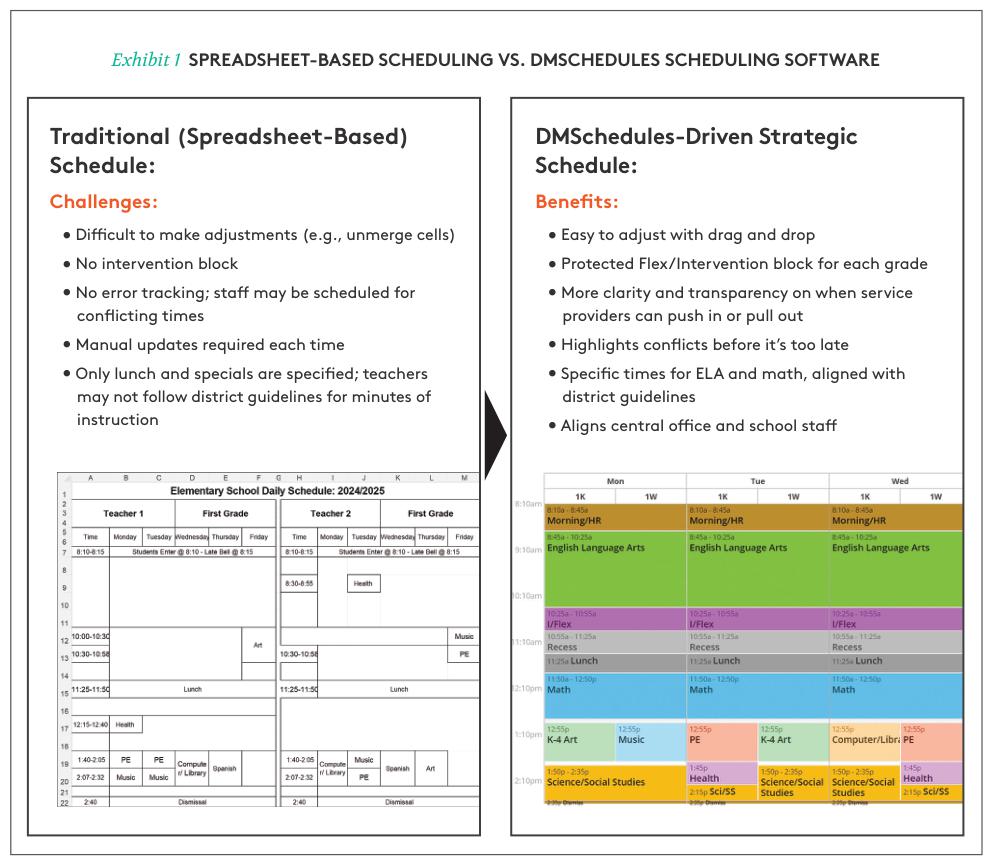
Because scheduling has grown much more complex, moving away from manual, spreadsheet-based scheduling and taking advantage of an efficient scheduling software tool such as DMSchedules can provide numerous benefits (Exhibit 1):
- Efficiency and accuracy: These tools are designed to identify interdependencies and conflicts, reducing mistakes and the extensive manual updates required with traditional methods. For example, districts using DMSchedules report saving up to 40 hours per school per year by eliminating manual work and improving staff coordination.
- Transparency and communication: Advanced software provides centralized scheduling information and sharing features that provide real-time updates to all staff, thereby improving communication and ensuring everyone is working from the most current version of the schedule. This transparency also allows administrators to easily see where students are and what is being taught throughout the day.
- Scenario modeling: Advanced software allows principals to quickly model and compare different scheduling scenarios, making it easier to examine the different schedules' impact on students and staff, and allowing for a discussion of tradeoffs before implementation. This creative problem-solving process is invaluable for designing optimal schedules.
Source: District Management Group
By implementing these best-practice strategies, districts can create elementary schedules that are not only efficient but also deeply aligned with their educational priorities, leading to improved outcomes for all students.
Key District Actions Needed to Implement Districtwide Strategic Scheduling
Implementing a strong districtwide strategy for elementary schedules that incorporates these best practices is a multifaceted endeavor; it's not a one-time fix but an ongoing commitment to continuous improvement. It requires clear leadership, a commitment to data-driven decision making that is connected with the district's broader philosophy for elementary education, and the adoption of appropriate tools and processes.
Below are key district actions needed to underpin a strategic districtwide scheduling strategy:
1. Conduct a Detailed Review of Scheduling Needs
Gain a clear understanding of your district's scheduling needs through a qualitative and quantitative analysis of current elementary school schedules, staffing practices, and program offerings. This review should assess:
- How time is currently distributed across subjects, specials, and interventions
- The availability of uninterrupted time for core instruction
- The efficacy and efficiency of current intervention and specialized student support approaches, including special education and multilingual education
- Equitable access to programs across all schools in the district
This analysis helps identify areas for improvement and opportunities to unlock existing staffing for new or different programs. District Management Group (DMG) frequently partners with districts to conduct these analyses.
2. Define Clear District Priorities
Using the learnings from the review, the district must articulate core educational priorities. What are the nonnegotiables for student learning? What are the key initiatives (e.g., literacy acceleration, multilingual learner support, social-emotional learning) that need protected time and resources? This clarity provides the foundation for all scheduling decisions.
3. Establish Clear Districtwide Guidelines for Staff Utilization
Using the priorities it has defined, the district then develops explicit guidelines for instructional time, direct service time for support staff, and appropriate group sizes for interventions. While the needs of individual schools and students may vary, district guidelines are critical to ensure that schedules are aligned with best practice. Monitoring these metrics regularly helps ensure that staff time is maximized for student-facing activities.

Fairfax County Public Schools (FCPS) supports students from a broad tapestry of countries and cultures. As such, the district has devoted substantial resources to multilingual instruction and English language proficiency. FCPS engaged with DMG to analyze six sample elementary schools to ensure that English language development (ELD) was provided to students in a way that complemented their literacy instruction.
Results from the analysis helped to inform districtwide scheduling guidelines that safeguarded core instruction while ensuring students receive ELD that corresponds with their needs. The work in FCPS resulted in the following specific benefits, among others:
- Improved guidance on competing service needs: The refined district guidelines supported how staff should balance the needs of multilingual learners who require special education services and other special classes to ensure that learners access uninterrupted core instruction while having their needs met.
- Clear expectations for staff roles and collaboration: The analysis revealed that much is asked of ESOL (English for Speakers of Other Languages) teachers, and guidance was needed for how much time ESOL teachers should spend in direct service of students versus collaborating with their colleagues. These clarified expectations allowed staff members to be more intentional with their time in support of improving outcomes for students.
4. Leverage a Common Specialized Scheduling Software or Tools
Moving beyond a generic tool to dedicated scheduling software is critical. Scheduling platforms such as DMG's DMSchedules provide the functionality to:
- Model various scenarios quickly and efficiently
- Identify conflicts and interdependencies in real time
- Ensure adherence to instructional minute guidelines and best practices
- Provide centralized, real-time access to schedules for all stakeholders so that leaders have visibility into the design of schedules and how students are accessing the variety of needed instruction
In addition to using scheduling software, some districts choose to partner more deeply with DMG by leveraging the "We Build It" model, where schedules are professionally built by DMG staff to ensure alignment and relieve the burden from school teams.
5. Foster Collaboration and Communication
A strategic scheduling process should involve key stakeholders from across the district and individual schools, including principals, teachers, and support staff. Workshops and focus groups can build alignment, gather feedback, and ensure that the schedules are practical and meet the diverse needs of the school community. Transparent communication about schedule changes and their rationale is paramount.
6. Commit to Ongoing Review and Adjustment
The needs of students and schools are dynamic. A strategic scheduling framework includes processes to regularly review schedules, assess student progress, and adjust groups and interventions as needed. This iterative approach ensures that the schedules remain responsive and effective over time.
Sustaining Improvement: The Long-Term Vision
Creating a strong district strategy for elementary schedules is not just about solving immediate problems; it's about building a sustainable system that continuously improves student outcomes. By optimizing the use of time and talent, districts can:
- Address learning gaps more effectively: By embedding dedicated intervention time and ensuring targeted support, districts can accelerate learning for struggling students and close achievement gaps.
- Enhance teacher effectiveness: Clear schedules that protect core instructional time and facilitate collaboration among teachers and support staff create a more supportive and productive environment for educators.
- Ensure equitable access to key programming: A districtwide approach ensures that all students, especially those with diverse needs, receive the consistent and high-quality support they require, regardless of their school.
- Maximize resource allocation: By efficiently leveraging existing staff and identifying opportunities to optimize programs, districts can make the most of their financial and human resources, even in times of budget constraints.
The complexity of modern elementary education demands a strategic, district-led approach to scheduling that maximizes the precious resource of time. By prioritizing student learning, optimizing staff time, and embracing innovative tools and collaborative processes, school districts can transform their elementary schedules from dreaded logistical exercises into powerful instruments for driving measurable and sustainable improvements in student outcomes. The investment in a strong district scheduling strategy is an investment in the future success of every student.
1 D. R. Superville, "Districts' Budgets Swell to Accommodate a Surge in Non-Teaching Staff," Education Week, August 13, 2014, https://www.edweek.org/leaders....