


Realizing Rapid Math Improvement in Huntsville City Schools (AL)
In public education, the pursuit of rapid student achievement gains is a constant, and often elusive, priority. In the winter of 2025, Huntsville City Schools (HCS) undertook an effort to accelerate math proficiency among its fourth-grade students, hoping to realize immediate gains on the Alabama Comprehensive Assessment of Progress (ACAP) in spring 2025.
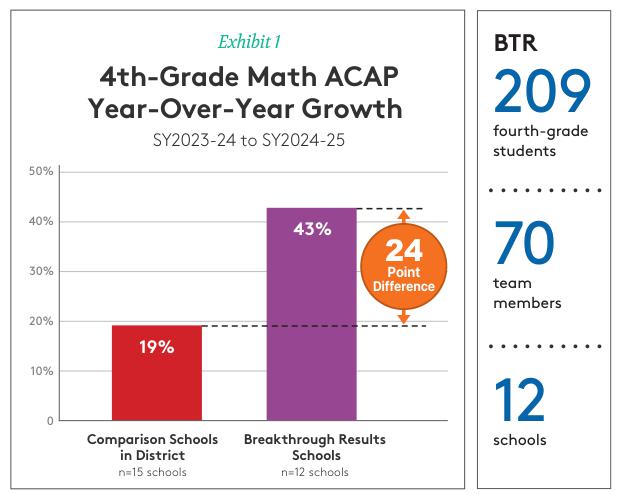
Partnering with District Management Group (DMG) to implement the Breakthrough Results (BTR) program, HCS successfully demonstrated how a focused, data-driven approach can lead to transformative outcomes for students in a short period of time. The HCS schools that implemented the BTR program saw a 43% increase in proficiency on ACAP over the prior year, a number that far exceeded the 19% growth in proficiency observed in a comparison group of the district's higher-performing schools that were not part of the BTR program (Exhibit 1).
Source: DMG and Huntsville City Schools
A Unique Context: The Importance of Math in the "Rocket City"
Huntsville, Alabama, is known globally as Rocket City due to its foundational role in the U.S. space program and its position as a center of the aerospace and defense industries. In the mid-20th century, a team of German rocket scientists moved to Huntsville to work for the U.S. Army. Today, Huntsville is home to Redstone Arsenal, the largest employer in the region, which is a hub for the U.S. Army Aviation and Missile Command and the Missile Defense Agency. Huntsville is also home to NASA's Marshall Space Flight Center. This unique environment is characterized by a high concentration of highly skilled professionals, including a significant number of Ph.D.s, who are a driving force behind the city's innovation and economic success.
In this context, strong math and science skills are not merely academic goals; they are essential for maintaining the city's intellectual and industrial leadership. For Huntsville City Schools, ensuring high levels of math achievement is critical to preparing students to access economic mobility in Huntsville.
The State Mandate: Raising the Stakes for Student Performance
The pressure to elevate student achievement in Huntsville is further intensified by recent state-level policy. The implementation of two high-stakes laws, the Alabama Literacy Act and the Alabama Numeracy Act, has changed the landscape of public education in the state. These new laws require students to meet specific proficiency benchmarks in reading by the end of third grade and in math by the end of fifth grade. Failure to meet these benchmarks can, in some cases, affect a student's promotion to the next grade level. This legislative framework creates a heightened sense of urgency for school districts across Alabama to ensure that every student is on a solid academic path. For Huntsville City Schools, programs like BTR not only are about local improvement but are also a direct response to these state mandates, providing a proven, rapid-cycle method to get students on track and ensure they are meeting critical proficiency requirements.
The BTR Framework: A Blueprint for Rapid Improvement
In spring 2024, just 28.2% of HCS' fourth-graders were proficient on the state's ACAP math assessment, which did not bode well for meeting the mandated math proficiency benchmarks by the end of fifth grade. HCS Superintendent Dr. Clarence Sutton had heard from his superintendent colleague Dr. Mark Sullivan of the strong gains in third-grade literacy achieved in Birmingham, Alabama, using DMG's BTR program. Dr. Sutton wanted to explore the possibility of using Breakthrough Results to address the concerning math gaps in Huntsville. The question was: with only a few months until the state proficiency exam, could students show meaningful progress on the ACAP?
In January 2025, Dr. Sutton reached out to DMG, and together, district leaders and the Breakthrough Results team shifted into action. The DMG team partnered with leaders in Huntsville to identify key focus areas on which growth could lead to outsized impact on ACAP—namely, data and measurement as well as geometry—and built focused SMART goals around these areas. The team also identified an approach to selecting target students and a progress-monitoring system that leveraged the district's existing tools (i-Ready diagnostic and the Savvas assessment platform). Seventy teachers, instructional coaches, assistant principals, and others participated in the Breakthrough Results program to elevate math achievement in a laser-focused way for 209 Huntsville fourth-graders, who represented 26% of enrolled students at focus schools.
Together, they implemented the core features of the Breakthrough Results program as illustrated below.
| Breakthrough Results Core Component | Approach at Huntsville City Schools |
|---|---|
| Determine a focus area aligned to the district's strategic goals | Fourth-Grade Math, specifically data and measurement and geometry domains. |
| Set a "SMART" goal | Focusing on students who scored one grade level below on i-Ready's mid-year diagnostic, the SMART goal was to ensure that a specific number of these students at each BTR school achieved more than 27 points of growth on the district's assessments from pre-test to post-test. The target group of students represented 26% of the total fourth-grade enrollment in these schools. |
| Determine a pre-test, post-test, and interim progress monitoring framework | The district created a pre-assessment, a post-assessment, and three progress-monitoring assessments using their Savvas platform and the bank of questions aligned to data and measurement as well as the geometry domains. |
| Determine an 8-to-10-week cycle for the work | The cycle ran from February 28, 2025, to May 2, 2025. |
| Weekly coaching by the DMG Performance Coach | Performance coaches met with team leads and teams of teachers weekly in virtual meetings, plugging into existing Professional Learning Community (PLC) structures. |
| Data visualization and data literacy skill development | DMG built a dashboard that was used biweekly by district, school, and teacher leaders to track student progress against their goals with the support of the DMG Performance Coach. |
| Rapid, iterative learning and strategy testing | Huntsville team members worked quickly, based on data, to try new strategies for improving math skills. For example, by looking at the data, teams realized the importance of explicitly teaching critical math vocabulary and ensuring student mastery of these terms. |
Source: DMG and Huntsville City Schools
Remarkable Student Outcomes: Evidence of a Successful Model
The most compelling story from the Huntsville BTR program is told through the student data. The results, measured across multiple assessments—ACAP, i-Ready, and Savvas—were nothing short of dramatic.
Unprecedented Growth on the ACAP
The most striking result came from the Alabama Comprehensive Assessment Program (ACAP) for fourth-grade math. BTR schools saw a 43% increase in proficiency, a number that far exceeded the 19% growth observed in a comparison group of higher-performing non-BTR schools in the district (Exhibit 1). This data point is a powerful testament to the program's effectiveness at a school-wide level. An impressive 10 out of the 12 BTR schools saw more students reach proficiency on the ACAP compared to the previous year, demonstrating the widespread impact of the program.
Doubling the District's Growth on i-Ready
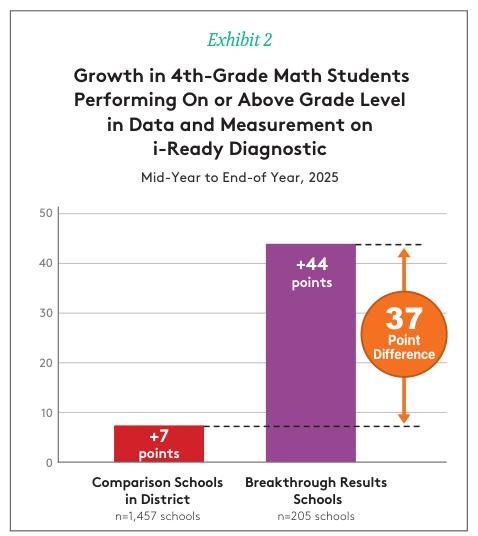
The i-Ready assessment, which measures student proficiency from mid-year (MOY) to end-of-year (EOY), also showed significant gains. BTR students gained an average of 29 points in overall i-Ready proficiency, which was 2.4 times the district's average growth of 12 points. This remarkable achievement highlights the program's success in accelerating the learning trajectories of its most in-need students. Furthermore, in the specific focus area of Data & Measurement, a key focus of the program, BTR students outpaced their non-BTR peers by an even wider margin, with a 44-point increase (Exhibit 2).
Source: DMG and Huntsville City Schools
Milestone Achievements on District-Created Assessments
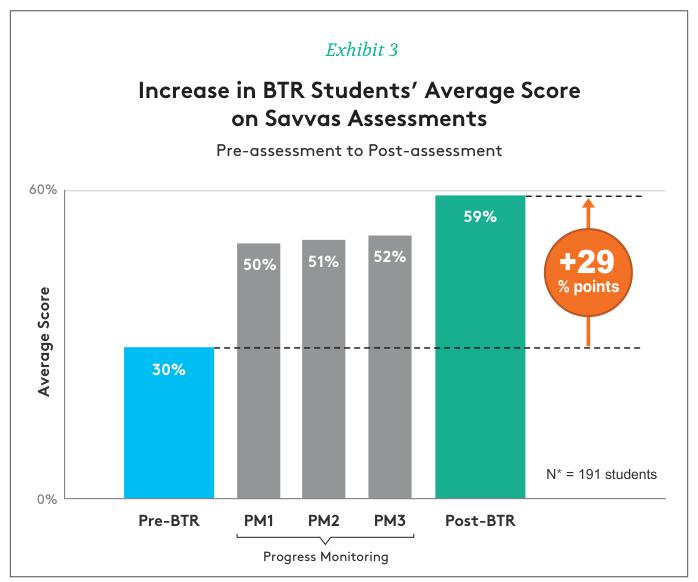
The rapid-cycle nature of the BTR program was further validated by the results from district-created Savvas assessments. From a pre-assessment to a post-assessment, BTR students increased their average score by 29 points. This continuous progress was visible throughout the program, with average scores steadily climbing from the pre-assessment to the post-assessment, with interim progress monitoring checks (PMs) serving as key indicators of progress (Exhibit 3).
Building Capacity: Fostering a Culture of Collaborative Improvement
The BTR program's impact extended beyond student scores; it also had a profound effect on the professional practices and collaboration among educators. The structured data cycles and weekly meetings provided a model for how to engage in purposeful instructional planning and monitor student progress in real time. "This was a great example of how PLC meetings should be structured. It inspired us to continue meeting regularly next year, using the same planning approach and responding," a Huntsville BTR team lead shared.
Looking Forward: Scaling Success in Huntsville
The success of the initial BTR program cycle in the spring of 2025 was a powerful proof of concept for Huntsville City Schools. "The Breakthrough Results program empowered our teachers to help their students to achieve outstanding results quickly. We are excited by the success we've seen with our students in just eight weeks," said Superintendent Clarence Sutton. The increases in fourth-grade math proficiency on the ACAP despite the short timeframe, combined with the accelerated growth on i-Ready and district-created assessments, have led the district to expand its use of the BTR program. The BTR program is now being implemented for both fourth- and fifth-grade math, aiming to replicate and scale these impressive results, and position HCS students for success in the context of the Alabama Numeracy Act.
This initiative serves as a model for other districts seeking to implement a rapid-cycle improvement process. It demonstrates that by establishing a clear focus, providing structured support, and empowering educators with data and collaborative routines, it is possible to achieve significant, measurable gains in a short amount of time.
Source: DMG and Huntsville City Schools *Only students with both pre- and post-test results were included in this analysis.
As one BTR principal noted, "We will continue to collaborate and use pre- and post-assessments to determine mastery of standards, while intentionally and effectively leveraging the right resources to support student learning."
This cultural shift toward data-driven collaboration and shared accountability is one of the most significant long-term outcomes of the program. The BTR dashboards equipped teams with the tools and routines to act on student-level data, fostering a sense of shared ownership for student progress. The process helped teams sharpen content knowledge and close instructional gaps, strengthening the alignment between curriculum and assessment vocabulary.
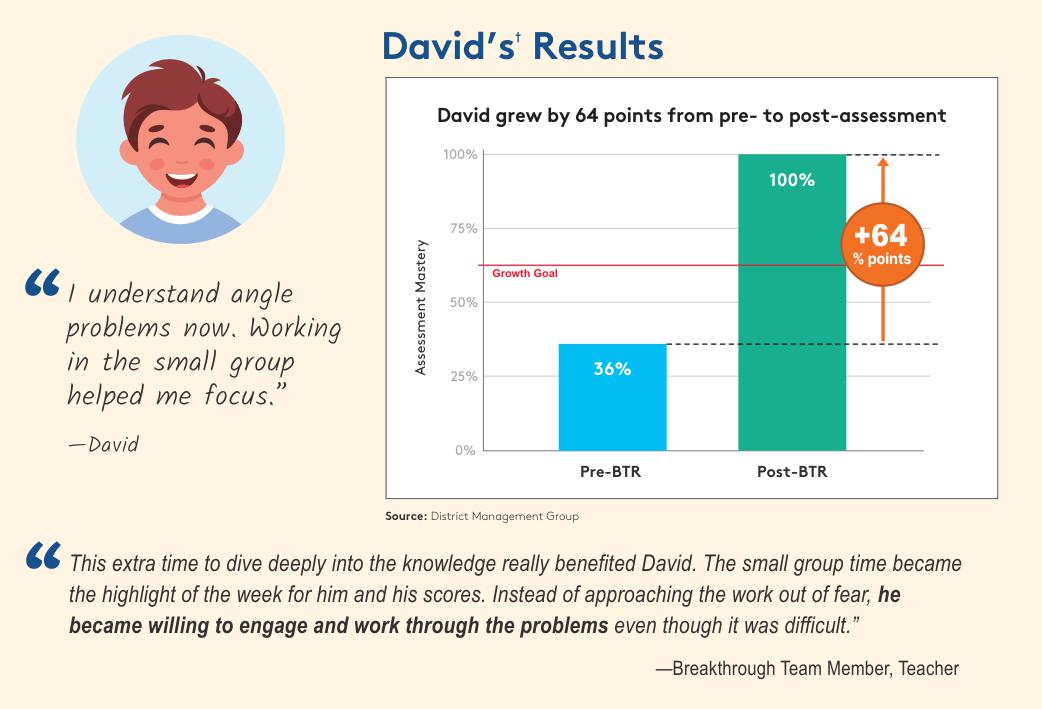
†Student's name has been changed.
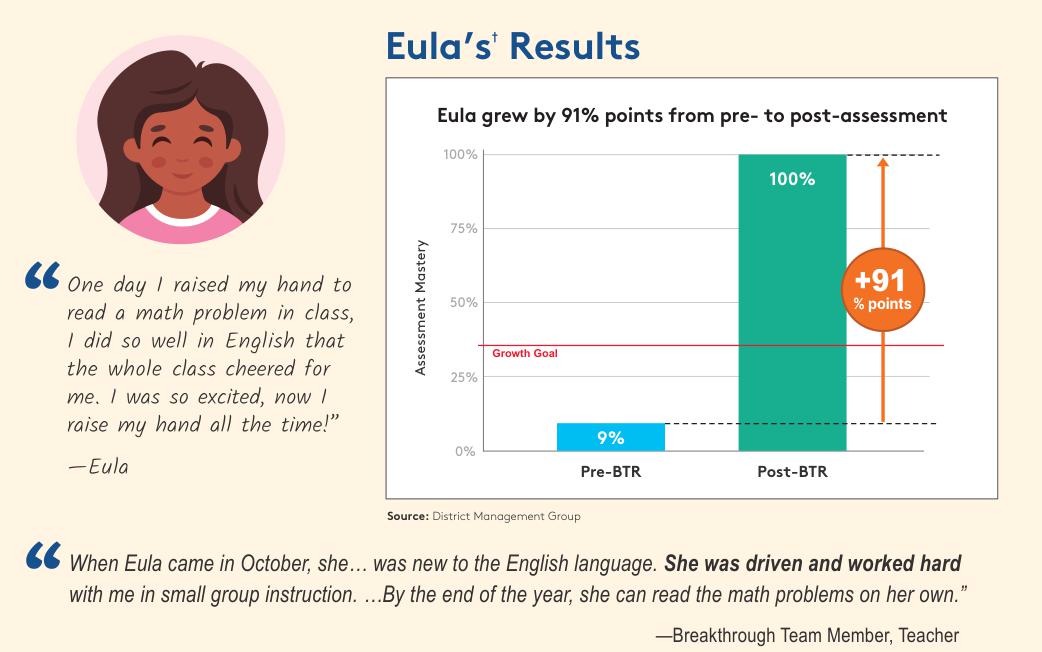
†Student's name has been changed.