

Visit the Acton Boxborough website to read the latest progress update. DMG’s detailed work can be found in the “Updates” section at the bottom ranging from June - December, 2025.
Charting a Course for Sustainable District Redesign
The District and the Challenge
Nestled in the western suburbs of Boston, Acton-Boxborough Regional School District (ABRSD) is by most measures a high-performing public school system. The district serves roughly 5,000 students across nine schools and two towns, prekindergarten through grade twelve. Its high school sends 95% of graduates to higher education, and its elementaries have earned National Blue Ribbon recognition. Its students and families represent more than 42 countries and speak 47 languages at home.
Despite its strengths, the district found itself facing a converge or pressures resulting from a few key factors:
- Enrollment had been declining steadily for years, and demographic projections showed no reversal on the horizon. Families just weren’t having as many children as they did historically, and enrollment was down over 10 percent since 2015.
- The cost of educating students was rising, particularly those requiring specialized services in special education and multilingual programs. Despite declining enrollment and thus lower staffing levels required, the district still had to eliminate over 50 positions to help balance the budget.
- Aging school facilities loomed as a future capital burden, and it was increasingly unlikely that the communities of Acton and Boxborough would increase local taxes further to offset increased costs.
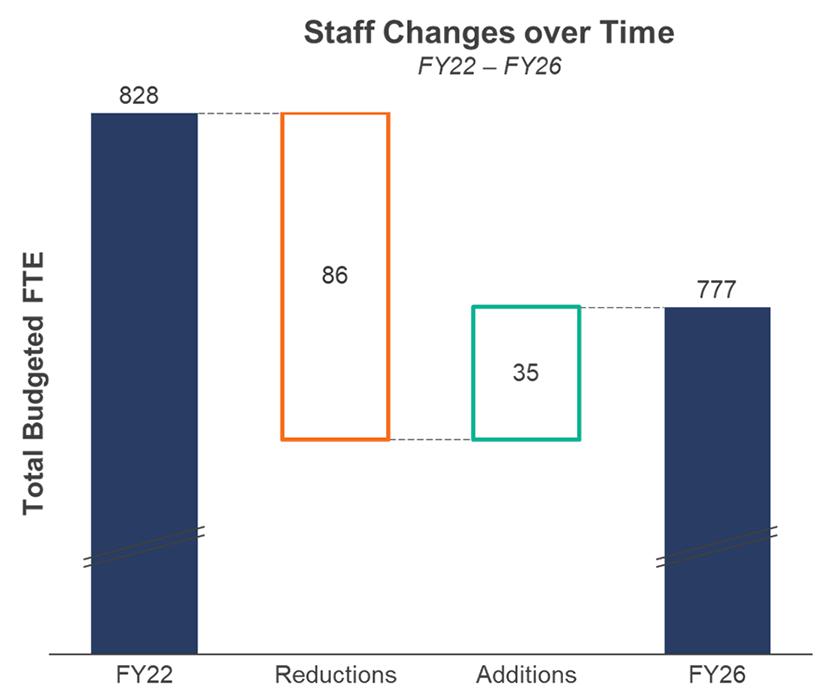
District leaders knew they could not continue without a change.
Communities Within Acton-Boxborough
Adding to the complexity, the broader communities of Acton and Boxborough, including parents, families, and educators, were far less aware of the depth of the fiscal and structural challenges. And ABRSD was not a district where change would come easily.
The district operated an open enrollment system in its six elementaries. Rather than assigning students to neighborhood schools based on geography, families ranked their preferred schools and the district placed students accordingly. Over decades, this model allowed distinct school communities to develop, each with its own culture, identity, and fiercely loyal families. Despite sharing physical buildings, schools operated as entirely separate programs.
The district needed to look closely at how it was organizing its schools and programs to find a solution. But any serious reorganization would not just move students between buildings, it would disrupt school communities that families had chosen, planned around, and deeply invested in. That reality made the work both necessary and politically treacherous.
Superintendent Peter Light approached District Management Group (DMG) with a clear-eyed understanding of the problems facing his district and an uncommon willingness to act on them. His elementary schools were underenrolled, and the configuration of his programs needed to change to provide services to students in a sustainable way. Together, ABRSD and DMG designed a strategic planning and district reorganization process to craft a plan for the future.
The Approach
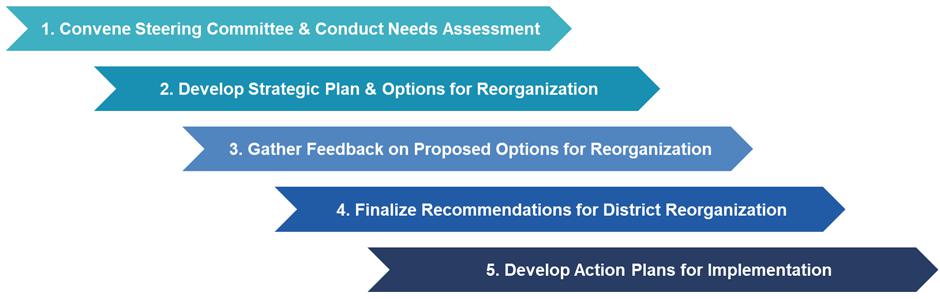
DMG was engaged to lead both a comprehensive strategic plan and a parallel reorganization study: two workstreams that cannot and should not be separated. Strategic goals without structural alignment are aspirational. Structural changes without educational vision are just logistics. The two had to move together, with the reorganization study guided by the strategic plan.
Ensuring Community Input
The process began by forming a steering committee composed of a diverse cross-section of stakeholders: parents, educators, administrators, and community members. This group was not a rubber-stamp body. Its job was to grapple seriously with data, weigh difficult tradeoffs, and ultimately provide the school committee with a credible set of reorganization options. Getting the right people in the room and giving them the right information was essential.
From the outset, ABRSD and DMG prioritized creating space for community members to learn. One of the core challenges with this kind of work is that the people most affected by decisions are often not well informed about the conditions driving them.
DMG and ABRSD leadership therefore designed a robust, multi-layered engagement process, including:
- Community surveys
- Focus groups
- Public forums
- Regular updates to the school committee.
The goal was not to manufacture consensus, but to ensure that when hard decisions were made, the community had genuinely participated in arriving at them.
Assessing the Current Situation
In parallel, the DMG team conducted a thorough analysis of the district's data: historical and projected enrollment, building capacities, budget trends, special education and multilingual program needs, and student geographic distribution. Using insights from this analysis, DMG modeled multiple reorganization scenarios with comprehensive analysis of the educational, operational, and financial implications of each, including the costs, the tradeoffs, and the feasibility given the district's physical infrastructure.
DMG analysis showed that district facilities were one of the most significant factors shaping the options available. Years ago in search of efficient configurations, the district had constructed two large elementary school facilities that could each hold two of their traditional elementary schools. These campus configurations, while innovative in concept, created spatial constraints that meaningfully limited which reorganization models were viable. Any credible set of options had to reckon honestly with what the buildings could actually accommodate.
Exploring Options for Reorganization
DMG also explored the educational design question at the center of the reorganization: what school configuration model would best serve students given current and future needs? One of DMG’s primary findings pointed toward a grade-banded model, organizing schools around upper and lower grade bands. The district historically operated many smaller PK-6 schools, so shifting to a model in which one school serves grades K-2 and another serves grades 3-5 had the advantage of coordinating student services more effectively. In a district where specialized services (i.e., reading specialists, math interventionists, special educators) are in high demand, larger concentrations of students within the same grade levels can allow for more coordinated, efficient, and effective service delivery. School size and configuration are not neutral choices in a world increasingly shaped by multi-tiered systems of support (MTSS). They have significant resourcing and programming implications.
In the spirit of comprehensiveness, DMG proposed 13 options for reorganization. Through discussions and workshops, the steering committee narrowed the options down to four. The fundamental trade-off facing the district was whether to attempt to A) limit the impact of disruption to fewer school communities or B) spread the disruption across the whole district.
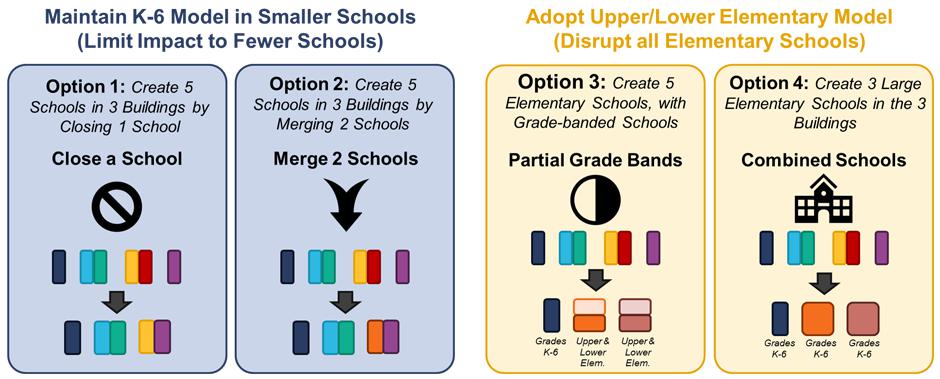
Is it better to limit disruption to fewer people even though that disruption could feel much more significant and personal? Or is it better to spread disruption across more people, creating a common experience for the community and providing a blank slate to rebuild?
Building Community Trust
Engagements of this kind are not just about analysis, but also largely about managing community expectations.
One key transition point was when the community came to learn that due to the reality of the situation, one elementary school would be facing closure. Closing a school was something that many parents, families, educators, and students knew was a possibility. One elementary building was facing tens of millions in necessary renovation costs. But many community members had been hoping that instead of closure, other alternatives could be leveraged. Managing this transition and assuring families this would be the right choice was as much a part of this work as the analysis that went into it.
A second challenging moment came at the final school committee meeting where the steering committee's recommendations were presented. The school committee members, who had been briefed on process and progress throughout the engagement, suddenly felt the full weight of what they were being asked to consider. Questions arose about whether all options had been fully explored and if the community was truly ready. It is not uncommon that there may be doubts throughout the entire process to the very end, but with consistent preparation and regular briefings, these, too, can be managed.
Lessons Learned and Takeaways for Your District
DMG delivered to the school committee a multi-year strategic plan aligned with its educational vision, a framework for improvement that would guide the district regardless of which reorganization path it chose. Shortly after, the set of reorganization options recommended by the steering committee was shared with the school committee, each accompanied by an analysis of educational implications, operational feasibility, and financial impact.
Ultimately, the district chose a path that spread disruption equitably across all school communities, deliberately avoiding the concentration of change in one or two schools while leaving others untouched. Paired with a shift to a grade-banded school configuration, this decision would allow the district to deploy its educators and specialists more efficiently, coordinate services more effectively, and build school communities of sufficient scale to sustain high-quality programming as enrollment continues to evolve. This approach was guided by the district’s strategic plan and theory of action.

The case of Acton-Boxborough will likely feel familiar for many districts. Declining enrollment. Rising costs. School models built for a different era. Communities that love their schools precisely because of the things that make them hardest to change.
What made the difference in Acton-Boxborough was not the absence of those challenges. It was the willingness of district leadership to name them clearly, build a process worthy of their complexity, and see it through even when the work got hard.

At District Management Group, we strive to empower and support leaders who embrace the challenge and solve the problem. To do this well, you need a process that empowers your leadership, engages your community, and ultimately puts your district on the right path, while preserving what makes the district special.