
For decades, the so-called reading wars divided educators. One camp favored whole language strategies and planned instruction with a focus on a student’s natural ability to learn language holistically. The other emphasized systematic instruction, such as discrete phonics instruction.
This lack of consensus left classrooms across the country with fragmented approaches to literacy. Then came the Covid-19 pandemic, which deepened learning loss and pushed reading outcomes to crisis levels. According to NAEP scores released in September 2025, fully one-third of U.S. eighth-graders are not reading at even the Basic level. These results mean that one out of every three eighth-graders in the U.S. cannot fulfill basic literacy tasks such as identifying the order of events, a character’s traits, or the main idea in a text1—skills that are generally mastered in elementary school.
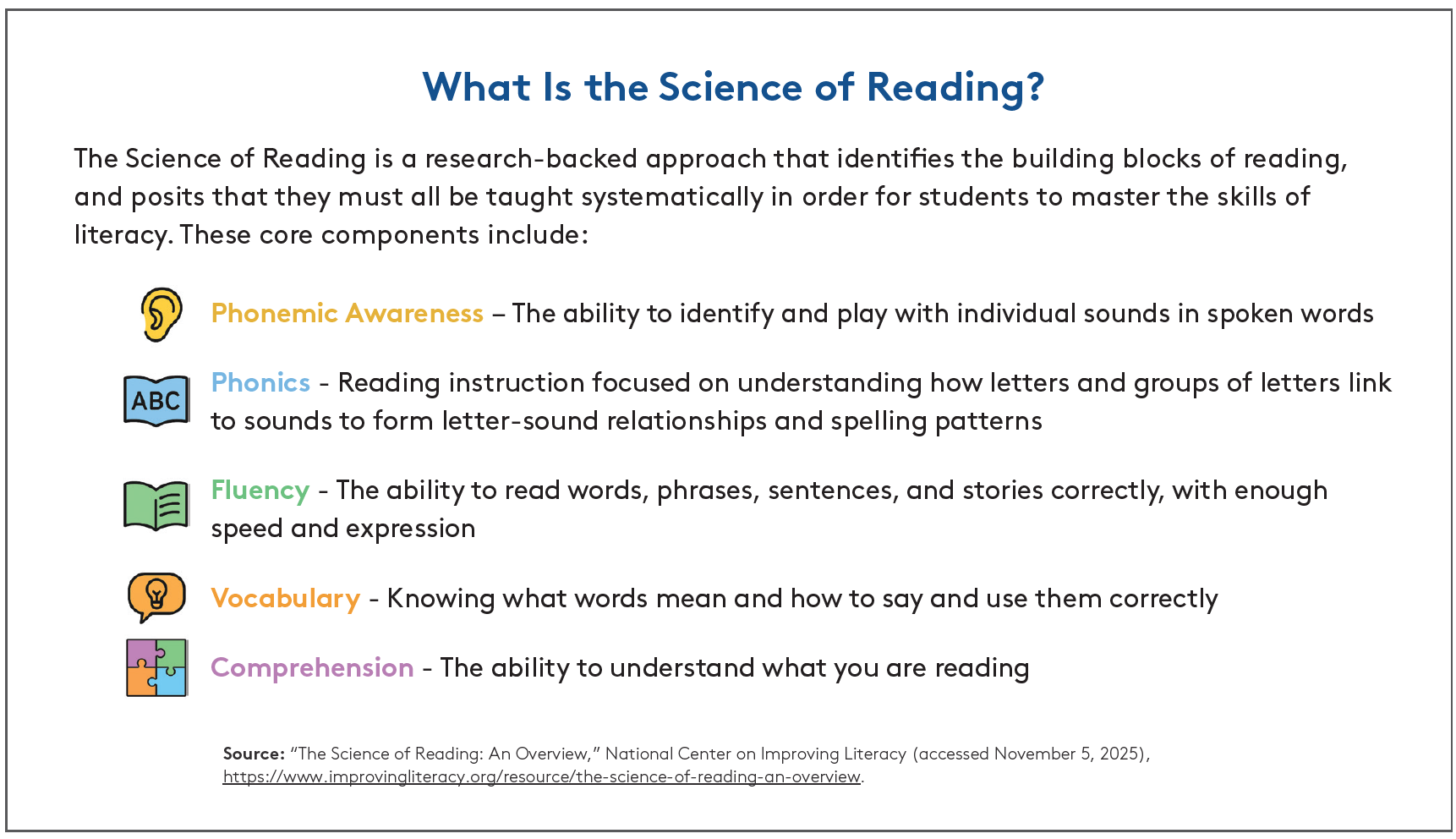
Against this backdrop, the debate is finally losing steam. A broad consensus is forming around the Science of Reading (SoR), which is not a single program or curriculum but a growing body of ever-evolving research that defines the essential components of effective literacy instruction.
The National Momentum for the Science of Reading
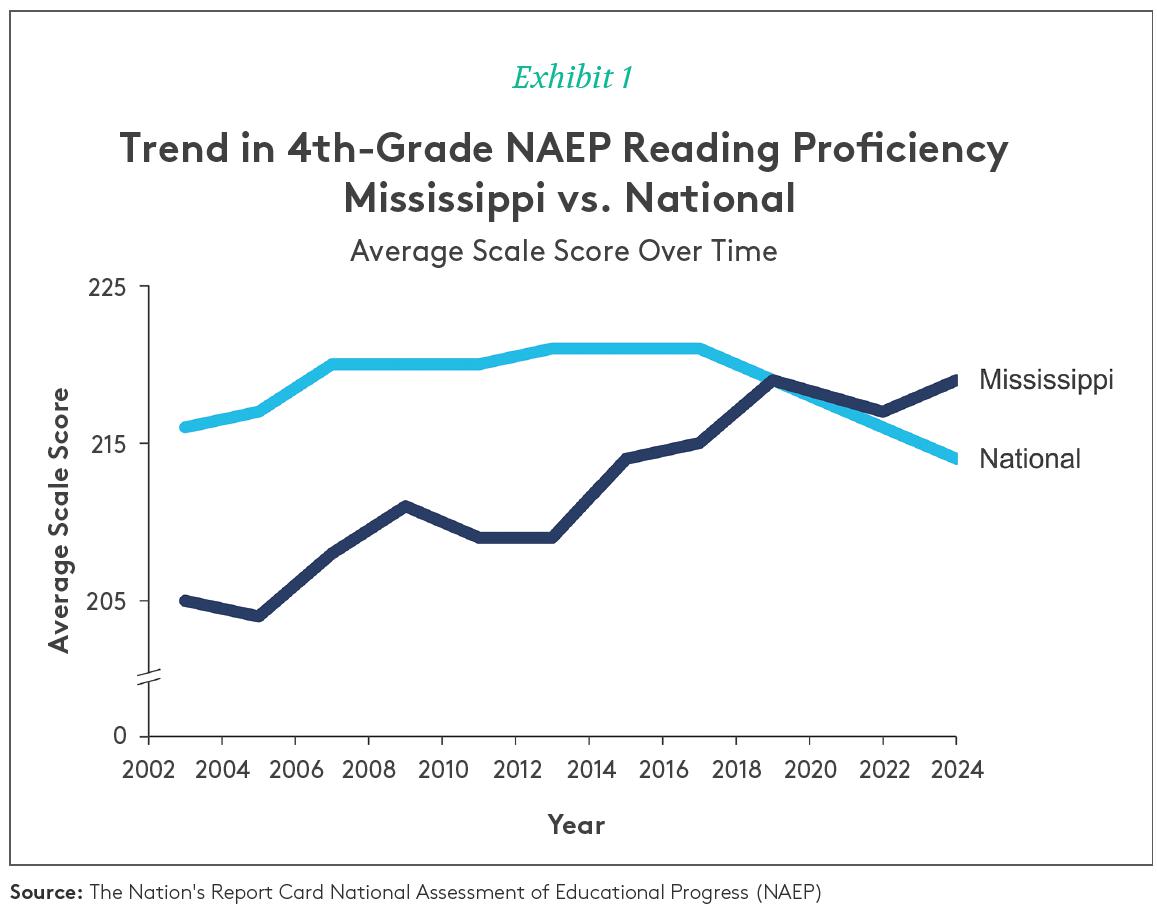
One early adopter of Science of Reading policies was Mississippi, which passed landmark legislation in 2013 requiring curriculum to be based on SoR. Student outcome data shows that this was the right move: on recent NAEP results, Mississippi shows a strong upward trajectory in fourth-grade reading, now surpassing the national average reading scale score for fourth-graders (Exhibit 1).2
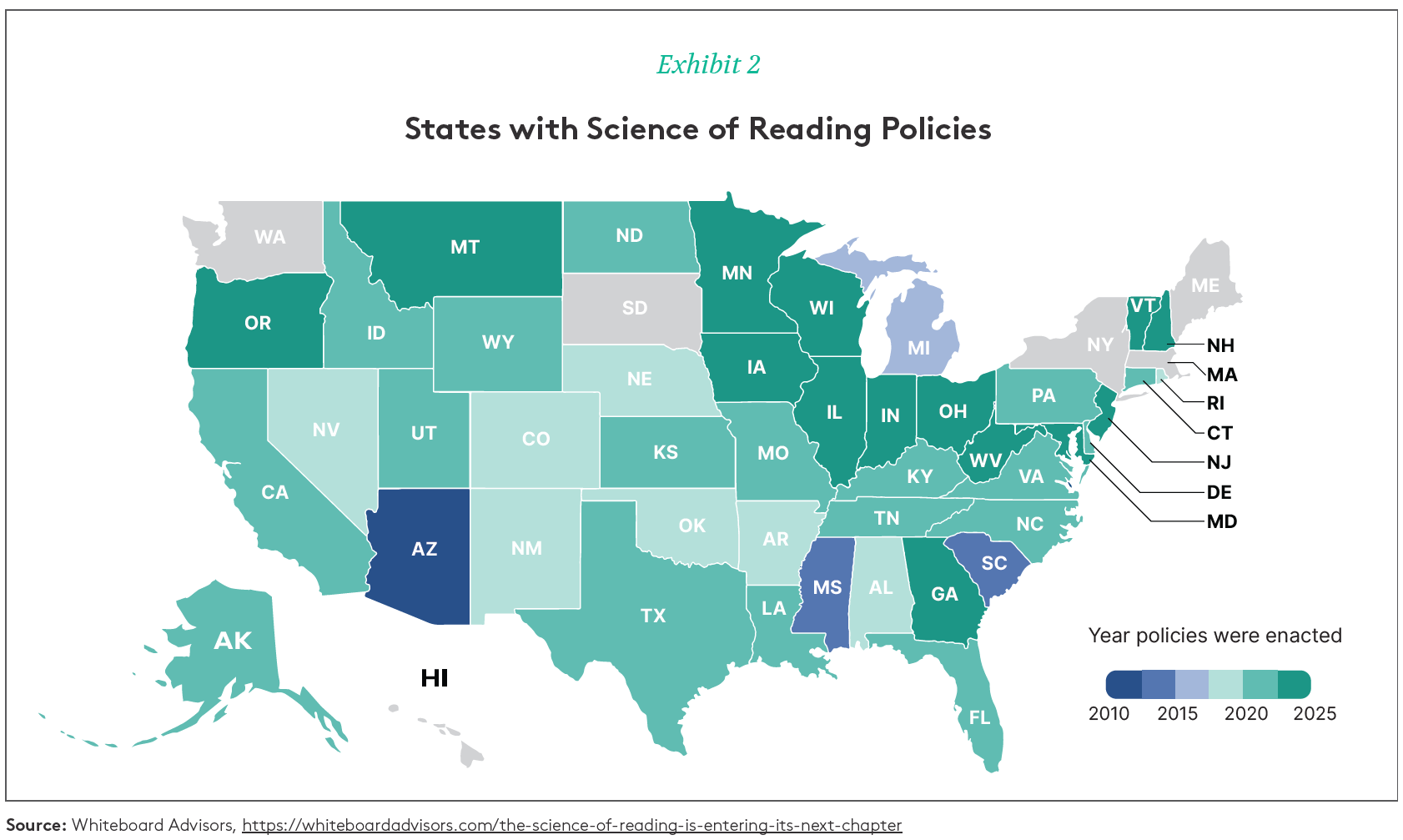
With Mississippi leading the way, now 40 states have policies mandating evidence-based literacy instruction. The movement has accelerated recently: in part spurred by the success of the podcast Sold a Story, 26 states adopted such policies in just the last three years (Exhibit 2).3
The Implementation Gap
Mandating the Science of Reading based on a strong research base is a meaningful first step, but it is just that: a first step. Curriculum companies have rushed to align their products with SoR, and in the last few years, there has been significant investment from school districts in these new high-quality instructional materials (HQIM) to support the transition to research-based practice in reading.
These policy advances and curriculum investments represent meaningful progress. Yet the most difficult challenge remains implementation in the classroom. The question is not whether the research or the materials exist, but how to ensure teachers consistently use these practices in ways that strengthen student literacy and improve outcomes.
This is where District Management Group’s Breakthrough Results (BTR) program has proven valuable. BTR equips districts to move from policy to practice by bringing to life the principles of the Science of Reading and activating teachers’ focus on a discrete skill. The program uses an improvement science approach—testing strategies in rapid cycles and using real-time data to scale what works.
At its core, Breakthrough Results is the education sector’s distillation of some of the most effective continuous improvement approaches drawn from other sectors, such as engineering and health care—Six Sigma, Total Quality Management, Kaizen, Lean, and others. Each of these models is built on the same principle: the relentless pursuit of performance through small, incremental improvements guided by frequent data.
BTR adapts these methodologies for the school context, but the process is the same: identify a key leverage point, test strategies in rapid cycles, use real-time data to adjust, and then scale what works. By applying this disciplined, improvement science–based approach, BTR helps districts not only achieve measurable gains but also build educator capacity to sustain them year after year. Given the Science of Reading’s focus on rigorous implementation of reading programs and student skill development based on data, it is a perfect use-case for the Breakthrough Results methodology.
The result is measurable gains in reading skills and the development of lasting professional capacity to sustain improvement.
Case Study: Grand Island Public Schools (NE)
Science of Reading Focus Area: Fluency
The Challenge: Many kindergarteners were not meeting benchmarks in phoneme segmentation fluency (PSF), while second-graders struggled with nonsense word fluency—words recoded correctly (NWF-WRC). Without fluency, students were stuck at the decoding stage, expending too much energy on sounding out words.
The Fix: The BTR coaches helped teams set aggressive yet achievable growth targets for fluency based on focus areas in kindergarten and second grade. Many teachers adopted new, structured routines, like repeated readings and partner practice. Others added detailed student monitoring, with students tracking the goal. Teachers also looked at very specific skills that students were missing and intervened with mini-lessons targeting gaps. Teachers and school-level coaches were able to identify strategies as a result of the BTR focus and progress monitoring. Weekly data reviews allowed teams to refine grouping and intervene quickly with students who were falling behind.
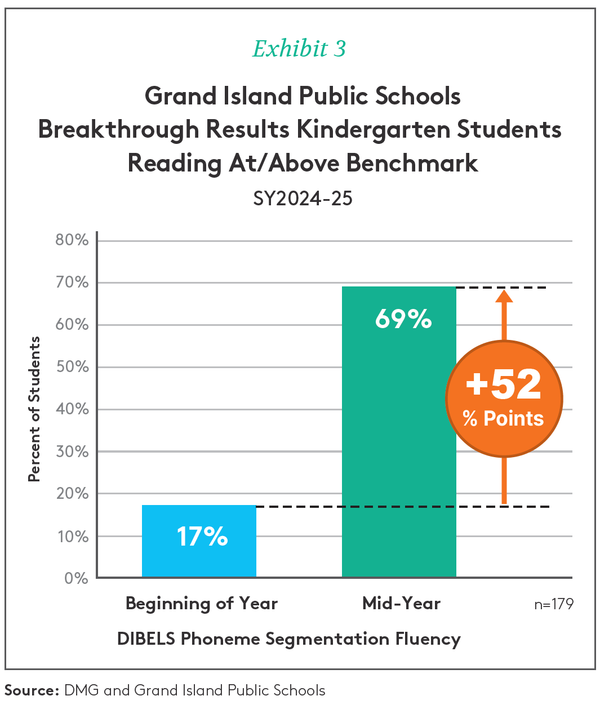
The Result: BTR students in both kindergarten and second grade saw significant gains in the fluency focus for that grade level (phoneme segmentation fluency for kindergarten; words recoded correctly/blending for second grade). For example, in kindergarten, 69% of students were at or above the mid-year benchmark on the DIBELS assessment at the end of the BTR cycle, compared to just 17% at the beginning of the year (Exhibit 3).
Case Study: East Baton Rouge Parish Schools (LA)
Science of Reading Focus Area: Phonemic Awareness
The Challenge: Pre-K students in East Baton Rouge Parish Schools (EBR) lacked foundational phonemic awareness, the ability to hear and manipulate sounds in words. This skill is one of the strongest predictors of reading success and can be built in pre-K to set kindergarten students on a strong path to becoming readers. The district wanted to increase the ability to blend onset-rime, a key early skill that allows children to connect sounds into words. Without intervention, these gaps would compound quickly, undermining the district’s broader goal of kindergarten readiness.
The Fix: Breakthrough Results Performance Coaches worked with pre-K teams to set clear, measurable goals (SMART goals) for increasing onset-rime blending. EBR teachers embedded short, daily routines for phonemic awareness practice, using multisensory tools like magnetic tiles to make the abstract concept of sounds more concrete. Weekly data reviews helped teams monitor progress and adjust instruction in real time.
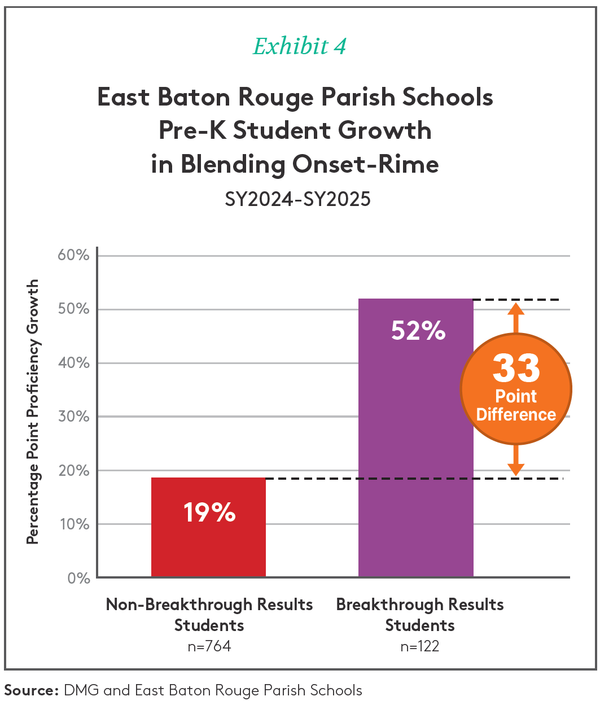
The Result: EBR's Breakthrough Results students showed remarkable growth, with a 52-point increase from midyear to end-of-year on a key phonemic awareness measure—2.7 times the growth of their peers (Exhibit 4).

Case Study: Birmingham City Schools (AL)
Science of Reading Focus Area: Vocabulary
The Challenge: Third-graders faced challenges accessing grade-level text due to limited vocabulary, a foundational skill for comprehension and knowledge-building.
The Fix: BTR teams implemented daily routines that focused on root words, prefixes, and suffixes. Structured “Blitz” routines helped students connect new words to authentic texts. Coaches guided teachers to use assessment data to adjust instruction, while students tracked their own progress.
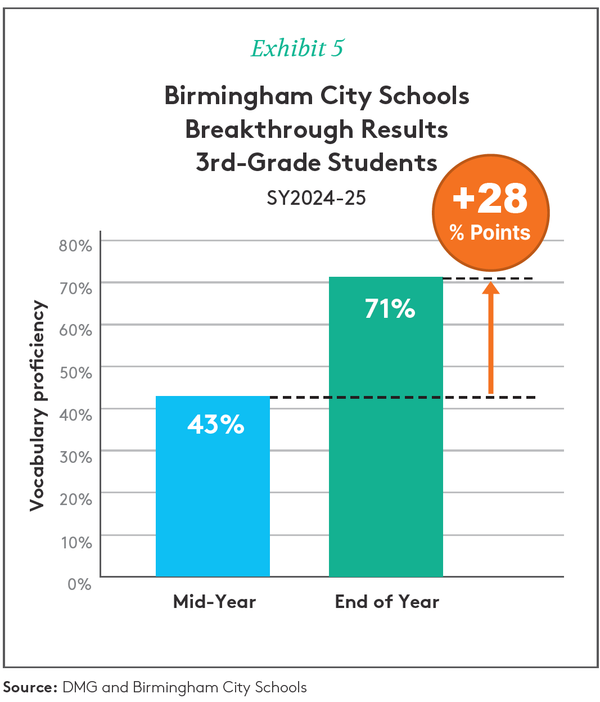
The Result: BTR students’ vocabulary proficiency increased by 28 points from mid-year to end-of-year (Exhibit 5), a gain seven times greater than that of their non-BTR peers. Importantly, Birmingham City Schools sustained the remarkable growth on the Alabama Comprehensive Assessment of Progress (ACAP) from the 2023-2024 school year, when they had implemented a fluency-focused Breakthrough Results program.
Lessons from the Field: What Makes Change Stick
District Management Group's Breakthrough Results Program has helped hundreds of schools successfully bring the Science of Reading to life in classrooms—and the BTR approach has proven just as powerful in other areas, from math instruction to attendance and beyond. A few key lessons stand out:
- Successful Change Programs Begin with Results.4 This is the driving principle of our Breakthrough Results model: it’s not about setting goals for compliance or process, but about setting performance goals that measure real student outcomes. When goals are tied to results—like gains in fluency, vocabulary, or comprehension—teachers can see tangible progress toward those benchmarks. That clarity builds urgency, motivates practice, and drives the kind of instructional shifts that truly move the needle for students.
- The Right Data at the Right Time: Most schools already have plenty of data, but it often comes too late or is too generic to guide instruction. BTR changes that by delivering actionable, timely data focused on specific literacy skills. Instead of waiting for end-of-unit or end-of-year reports, teachers are reviewing progress weekly and using it to make immediate instructional adjustments. With the right information at the right moment, teachers know exactly which students need a shift in approach and which strategies from their Science of Reading toolkit will work best.
- Real-Time Coaching That Translates into Sustained Practice: Professional development alone rarely shifts practice. It’s too often disconnected from the daily challenges teachers face. Embedded coaching, however, sticks. When support is tied to real-time data and to the very students in front of them, teachers are far more likely to adopt and sustain new strategies. That’s why DMG coaches don’t wait for the next training cycle. They plug directly into existing professional learning community (PLC) structures and offer in-the-moment feedback. Teachers can immediately try a suggested adjustment during instruction, see how it works with their students, and refine it in real time. This rapid application accelerates teacher growth, builds confidence, and ensures professional learning leads to meaningful, lasting change in classrooms.
The move to get the Science of Reading to anchor U.S. classroom pedagogy and practice is research-based and well-intentioned, but it all hinges on strong implementation. For this reason, having an implementation partner such as DMG’s Breakthrough Results team can bring the Science of Reading to life, building data literacy for teachers and activating that on-the-ground knowledge base—which leads to strong and sustainable results for students.
Notes
1 “10 Takeaways from the 2024 NAEP Results,” NAEP (accessed November 5, 2025), https://www.nagb.gov/powered-by-naep/the-2024-nations-report-card/10-takeaways-from-2024-naep-results.html#:~:text=On%20a%20500%2Dpoint%20scale,either%20grade%2C%20compared%20to%202022.
2 “NAEP Reading: US Reading Score Trends,” NAEP, 2024 (accessed November 5, 2025), https://www.nagb.gov/naep/reading.html
3 Anna Kimsey Edwards, “The Science of Reading Is Entering Its Next Chapter,” Whiteboard Advisors, October 14, 2025, https://whiteboardadvisors.com/the-science-of-reading-is-entering-its-next-chapter/
4 Robert H. Schaffer, “Successful Change Programs Begin with Results,” Harvard Business Review (1992).