

The complexity of secondary scheduling often leads schools to default to outdated practices that may not align with current district priorities or student needs. As a result, schedules increasingly become less effective and efficient, both in terms of time and staffing.
A real-world case study of San Bernardino City Unified School District (SBCUSD) in California illustrates how schools can rethink time and staffing to better serve students and maximize middle and high school schedules— all without increasing costs.
Inside San Bernardino City USD’s Secondary Scheduling Transformation
Located in San Bernardino County in Southern California, San Bernardino City Unified School District (SBCUSD) serves approximately 45,000 students across 74 schools, including 11 middle and 7 high schools. District-wide, approximately 82% of students identify as Hispanic/Latino, about 9% as Black/African American, 2% as Asian, and 4,2% as White. Nearly 89% of students are economically disadvantaged, and around 23% are designated English Learners. The district operates with a substantial budget and dedicated staff structure, offering a wide range of specialized programs—including career pathways and International Baccalaureate tracks.
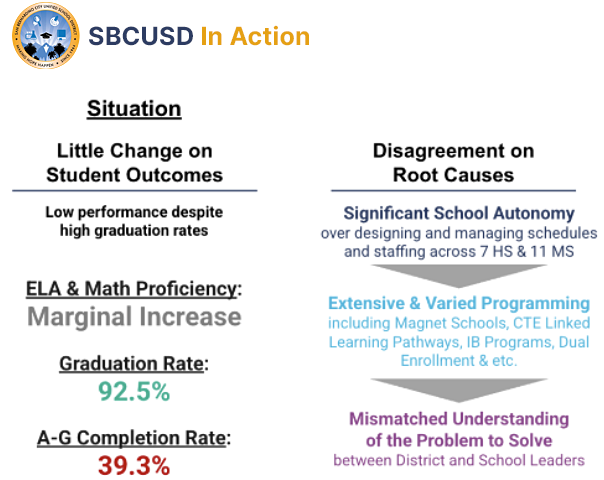
Due to the extensive range of program offerings, staffing and scheduling were complex and inconsistent across schools, lacking a shared, strategic approach in the secondary grades. Principals voiced frustration over insufficient staffing, while the central office believed schools were receiving more than necessary based on enrollment data. Tensions between sites and the district office escalated as priorities collided and resource allocation appeared misaligned with student needs.
Sudha Venkatesan, Director of Secondary Education - College & Career at San Bernardino City Unified School District (SBCUSD) found herself caught in the middle of ongoing friction between secondary principals and central administration. The lack of a shared, strategic scheduling process meant both sides operated on different assumptions, leading to conflicting views and frustrations. Venkatesan, in her role, had to navigate these competing perspectives without clear, objective data to resolve the disagreement—prompting her to seek outside expertise to bring clarity and alignment.
Recognizing the need for objective, data-driven insight, Venkatesan led the effort to partner with District Management Group (DMG) to analyze secondary schedules and staffing practices, with the goal of identifying root causes and building more effective, equitable scheduling systems.
From Insights to Action
DMGroup conducted a High School Scheduling Opportunity Review, combining qualitative and quantitative analysis of San Bernardino's high school schedules, practices, and processes. The goal was to identify areas for improvement and provide recommendations for alternative scheduling approaches.
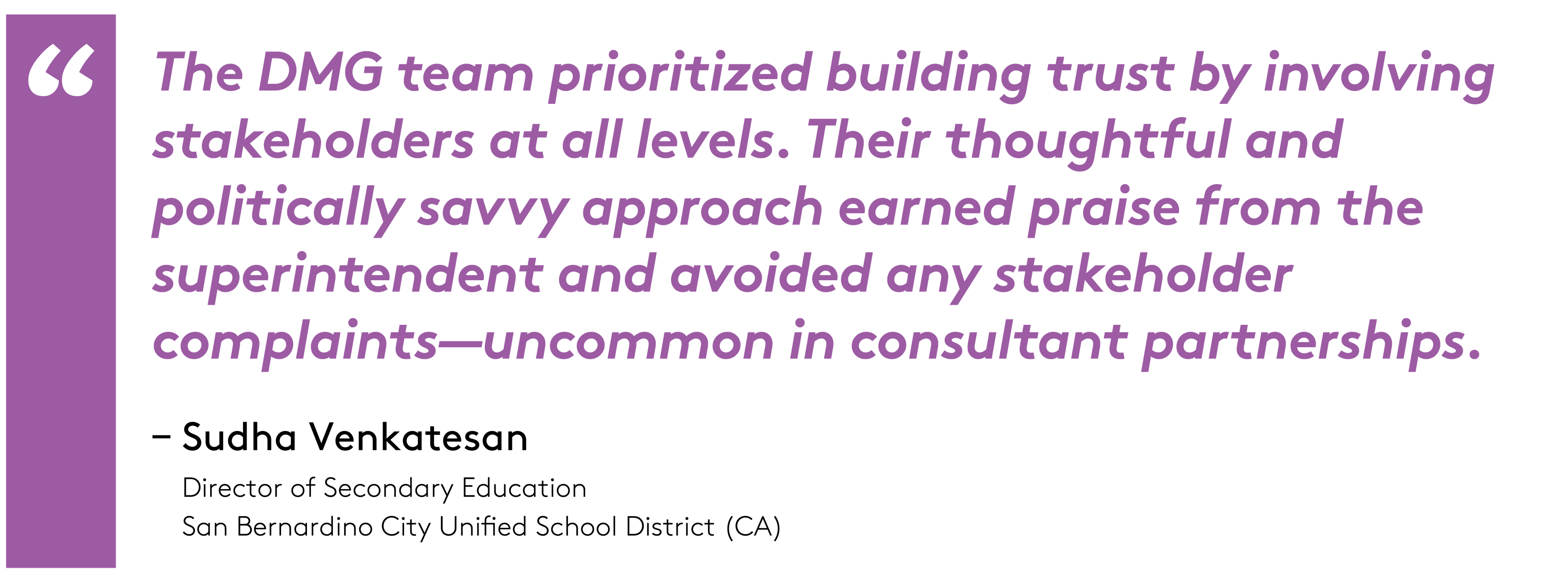
Contrary to initial assumptions, the review showed that San Bernardino’s high school schedules themselves were not the problem—they were already structured effectively to support student needs. The real challenge was program prioritization. Schools were expected to run too many programs at once, many of which competed for the same staff, time, and resources. Using insights from the review, the district revised its guidance on which programs schools should offer. This helped streamline choices, reduce competition for staff, and make scheduling significantly more manageable across schools.
“Rather than completely redesigning schedules, the district shifted its focus to improving the instruction happening within high school schedules,” said Joe Costello, DMGroup Director.
The High School Opportunity Review also highlighted how many students were starting high school below grade level. This finding prompted the district to want to take a closer look at how middle school schedules were structured—seeking to ensure students are better prepared before reaching high school.
Reworking Middle School Schedules to Strengthen Instruction and Equity
A follow-up Middle School Review conducted by DMG revealed that inconsistent scheduling across the district’s 11 middle schools was leading to mixed results for students. In particular, there was often a lack of alignment in time dedicated to different types of instruction, with some students receiving nearly half the core instructional time of their peers. This lack of sufficient time in subjects like math and ELA was tied to weaker academic outcomes.
The findings resonated strongly with the superintendent and cabinet, leading to immediate schedule redesigns.
Middle school schedules were reworked to ensure alignment with non-negotiables and a stronger focus on core instruction.
The district implemented a bounded-autonomy model, allowing school-level flexibility within clearly defined instructional time parameters.
The approach to targeted intervention was strengthened to address specific academic gaps and ensure students received the necessary support to meet grade-level standards.
Addressing Staffing Inequities
Throughout the high school and middle school reviews, DMG identified staff allocation issues across all schools.
In response, the district re-engaged DMG to gain a clear and accurate understanding of current staffing levels and practices, and to gather actionable insights for more effective staff allocation.
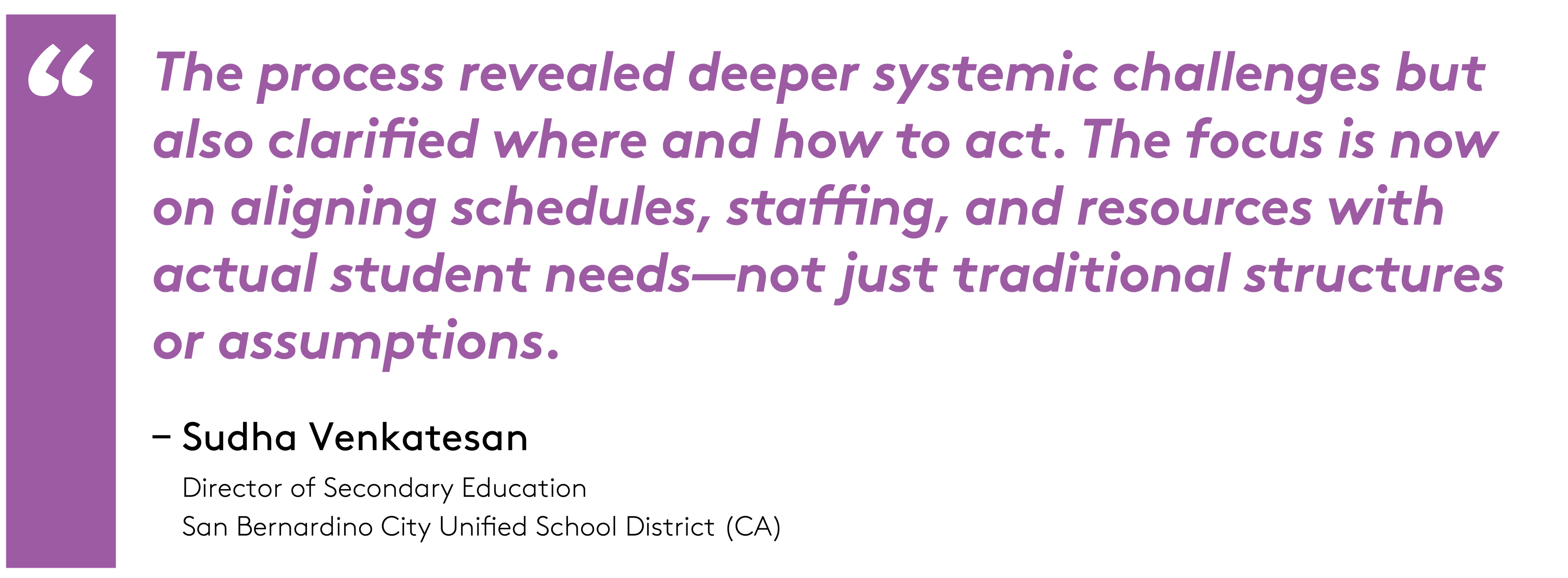
Discussions with school leaders revealed that while the district had a standard approach to baseline staffing, there was uncertainty around how additional positions and programs were allocated, leading to disparities between schools. These insights prompted a comprehensive review of staffing levels across the district, resulting in conversations with school and district leaders about how staffing and resourcing should align with student needs and programs, along with clear recommendations for redesigning the staffing process.
Strengthening District Collaboration in Critical Resource Allocation Decisions
DMG’s work also highlighted the importance of aligning the academic, staffing, human resources, and budget teams in the decision-making process. In many districts, budget and staffing leaders make decisions that significantly impact schools—often without the involvement of teaching and learning leadership. This lack of involvement isn’t due to disinterest from instructional leaders, but because they’re not intentionally included in the process.
DMGroup’s work underscored the need for strong collaboration among all branches of district leadership when making critical resourcing decisions.
The DMG and SBCUSD partnership shows how a thoughtful, hypothesis-driven approach to problem solving can help a district identify root causes and focus on the most effective solutions. In San Bernardino, this meant shifting attention from high schools to middle schools to improve instructional time and refining staff allocation to direct resources where they’d have the greatest impact on student outcomes.